Every week, beauty brands lose money to the same problem. A product that passed internal quality checks, looked great in the showroom, and photographed beautifully arrives at a customer's door in pieces. A cracked glass bottle. A pump that separated from the collar. A serum that leaked through the carton and soaked everything else in the box.
The one-star reviews come in. The refund requests follow. And somewhere in the brand's supply chain, someone says the same thing they always say:
"We need a stronger box."
They are almost always wrong.
The drop test is not the problem. Your packaging system is.
Amazon's drop test - part of their ISTA 6-Amazon standard, simulates what happens to a package during fulfillment and last-mile delivery. A box is dropped from a specific height, at specific orientations, a specific number of times. It sounds simple. For most beauty brands, it is where everything falls apart.
But here is what most people misunderstand: the drop test is not trying to break your box. It is trying to break your product. The box is just the delivery mechanism. If your product is failing the drop test, the question is not "how do I make the box survive the drop?" The question is "why is energy from that drop reaching my product?"
That distinction between box survival and product survival is where most beauty packaging fails to make the leap.
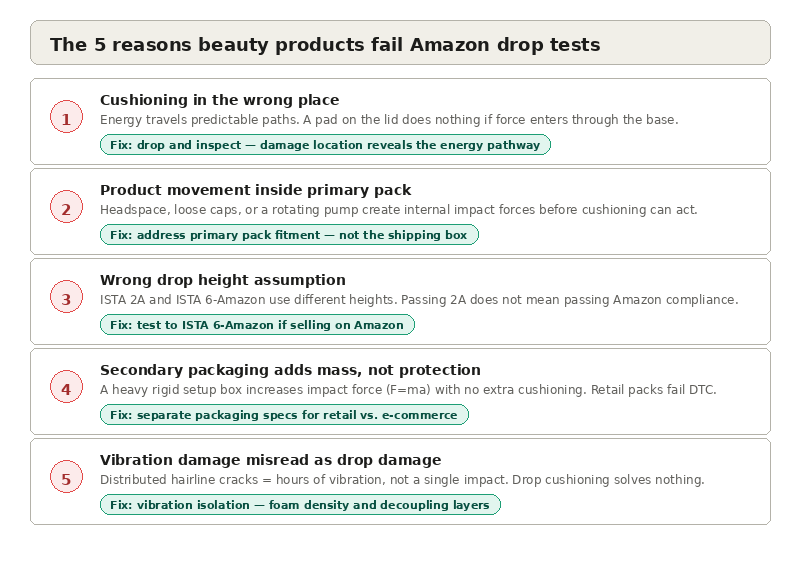
The five reasons beauty products actually fail drop tests
After reviewing hundreds of packaging failures across beauty and personal care, the root causes almost always come down to five things. Not in every case, and rarely in isolation — but if your product is failing, at least one of these is the reason.
1. Insufficient cushioning — but not where you think
The instinct when a product breaks is to add more foam, more void fill, more padding. Sometimes that is right. More often, the cushioning is in the wrong place entirely.
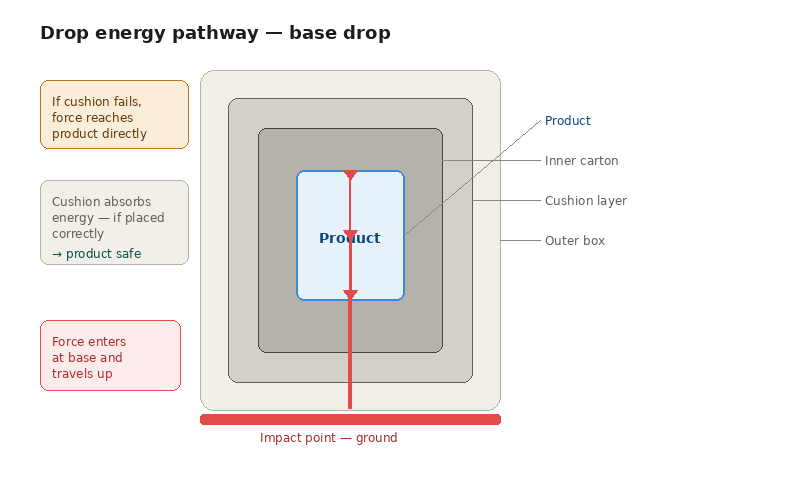
Drop energy travels through a package along predictable paths. A glass bottle dropped on its base transmits force up through the bottom, through the product, and into whatever is above it. A pump bottle dropped on its corner concentrates force at the most fragile point — usually the neck-to-shoulder junction. Adding a foam pad to the lid does nothing if the energy pathway bypasses the pad entirely.
Before you add cushioning, you need to understand where the energy is going. That means dropping the package, opening it, and looking at where the product actually shows damage. That tells you more than any spec sheet.
2. Product movement inside the primary pack
This one is almost exclusive to beauty. A foundation bottle with 20% headspace. A skincare jar with a cap that has 2mm of vertical play. A perfume bottle that can rotate inside its collar.
Primary packaging that allows product movement creates internal impact forces that no amount of outer cushioning can fully absorb. When the package hits the ground, the product moves inside its own container and impacts itself. Glass hits glass. A heavy pump mechanism drops onto a glass shoulder. The damage happens before the outer box has even finished deforming.
The fix is almost never in the shipping box. It is in the primary pack design or the fitment between primary and secondary packaging.
3. Wrong drop height assumption
ISTA 6-Amazon specifies drop heights based on package weight. Lighter packages get dropped from higher heights — because lighter packages travel through more of the fulfillment network by hand, and hands drop things from higher positions than conveyor systems do.
Many beauty brands — particularly those launching on Amazon for the first time — test to ISTA 2A, which uses different drop heights and orientations than ISTA 6-Amazon. They pass ISTA 2A, assume they are compliant, and fail their Amazon SIOC evaluation six months later when they finally submit it.
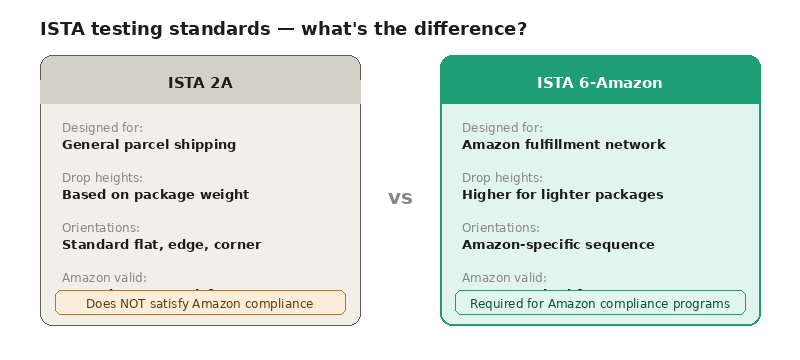
If you are selling on Amazon, test to ISTA 6-Amazon. Not ISTA 2A. Not your own internal protocol. The standard Amazon will actually evaluate you against.
4. Secondary packaging that adds weight without adding protection
A rigid setup box. A magnetic closure carton. A premium rigid base and lid. These are beautiful in a retail environment and actively harmful in an e-commerce distribution channel.
Rigid secondary packaging adds mass to the package without adding meaningful cushioning. Mass increases the force of impact on drop — force equals mass times deceleration, and deceleration is fixed by the floor. More mass means more force on the product at the moment of impact, with no additional energy absorption to compensate.
Brands that sell the same product in retail and DTC channels often need two different packaging systems. The retail pack that looks stunning on a shelf is frequently the worst possible choice for a box that will be dropped eight times between a fulfillment center and a doorstep.
5. Vibration damage misidentified as drop damage
This one catches even experienced engineers. A product arrives with hairline cracks in the glass. The caps show stress marks. The brand assumes it was dropped hard. It was not — it vibrated for four hours in a delivery van.
Vibration damage and drop damage look similar but have different root causes and different solutions. Drop damage tends to be localized — a crack at a stress concentration point, a pump that sheared at its weakest cross-section. Vibration damage tends to be distributed — multiple small fractures, abraded surfaces where packaging components have been rubbing against each other for hours.
If you are seeing damage that does not look like a single impact event, stop adding drop cushioning and start looking at vibration isolation. Foam density, decoupling layers between components, and surface protection between primary pack and inner carton are where the solution lives.
What to do before your next product launch
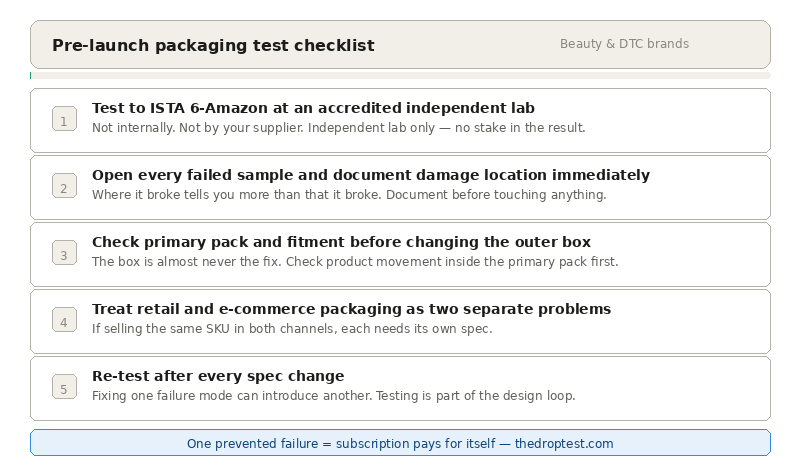
If you are launching a beauty product on Amazon or any DTC channel, here is the minimum viable testing sequence before you commit to a packaging spec:
First, get your ISTA 6-Amazon test performed by an accredited lab — not internally, not by your packaging supplier. An independent lab with no stake in whether your packaging passes or fails.
Second, open every failed sample immediately after the test and document where the damage occurred before you move anything. The failure location tells you more than the failure itself.
Third, do not change the box first. Look at the primary pack, the fitment between primary and secondary, and the void fill system. The box is almost never where the fix belongs.
Fourth, if you are selling the same SKU in retail and e-commerce, treat them as two separate packaging problems. They are.
Fifth, test again after changes. A spec change that fixes one failure mode sometimes introduces another. The only way to know is to test.
The bottom line
Amazon's drop test is not a hurdle to clear once and forget. It is a diagnostic tool. Every failure is telling you something specific about where your packaging system is breaking down — whether that is cushioning placement, primary pack fitment, testing standard mismatch, secondary packaging mass, or vibration sensitivity.
The brands that figure this out early spend less on chargebacks, less on product replacements, and less on emergency re-engineering after launch. The brands that keep blaming the box keep having the same problem.
If your beauty product is failing in transit and you are not sure where to start, the answer is almost always the same: open the damaged package before you throw it away, and look carefully at where the product actually broke. That is where the problem is.